
4 October 2026
Roofers In Sutton-in-Ashfield And Kirkby-in-Ashfield: What Changes Once You Cross Into Ashfield
Planning, building control via Erewash, system-built council houses, old pits and repair prices - a roofer's guide to Sutton-in-Ashfield and Kirkby-in-Ashfield.
Drive west out of Mansfield past King’s Mill Reservoir and somewhere around the hospital you leave Mansfield District and enter Ashfield. Nothing on the ground tells you. The terraces look the same, the 1930s semis look the same, and the roofs on them fail in the same ways. But Sutton-in-Ashfield and Kirkby-in-Ashfield answer to a different council, and that council has handed one of its main roofing-related functions to an authority in Derbyshire. Add a stock of system-built post-war council houses, a ring of closed collieries and the highest ground in Nottinghamshire on the western edge, and there’s enough here that a homeowner in NG17 should know before calling anyone. Paperwork first, then the houses, then the money.
Same patch, different council: what Ashfield handles for a roofing job
Ashfield District Council runs planning for Sutton, Kirkby, Huthwaite, Skegby, Stanton Hill and Annesley from its offices on Urban Road in Kirkby. For most roof repairs that is the end of the council’s involvement, because replacing like with like doesn’t need permission.
Building regulations are the part people trip over. Strip and re-cover more than about a quarter of a roof and the insulation rules usually apply, which means either a roofer who can self-certify through a competent person scheme or an application to building control. In Ashfield the council makes the decision, but Ashfield’s building control page confirms that Erewash Borough Council handles applications and payments for the district. So if your roofer says “we’ll sort building control,” ask whether that means a self-certificate or a form sent to Erewash. Either is fine. Neither, on a full strip, is not. Our roof replacement service notes which route a job is taking on the written quote, so you don’t have to ask twice.
Conservation areas are the other thing to check. The district has six: Annesley, Lower Bagthorpe, Kirkby Cross, Sutton in Ashfield Church and Market Place, Teversal and Hucknall, all listed on the council’s conservation areas page with maps. Kirkby Cross also has an Article 4 direction, but it protects the stone boundary walls along Church Hill rather than roofs. Inside any of these areas, changing what a roof looks like from the street is the bit that needs a conversation with the duty planner first.
What Sutton and Kirkby roofs are actually built from
Both towns grew on coal, and Sutton grew on hosiery as well, so the oldest housing is late Victorian and Edwardian terracing close to the centres.
Those terraces were mostly roofed in Welsh slate, and the slate itself often outlives the nails holding it. When a slate slides down a Sutton terrace roof the slate is usually sound. It’s the iron nail that has rusted through, and if one has gone, the rest of that generation of fixings isn’t far behind. Party-wall chimney stacks shared between two houses are the other recurring job, because nobody wants to pay for half of something the neighbour won’t fix.
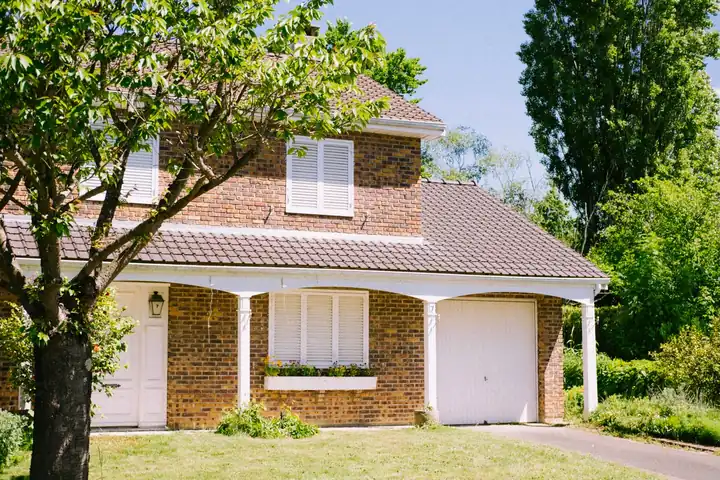
The interwar and post-war semis that fill much of Kirkby and the edges of Sutton tend to wear concrete interlocking tiles now, either original or from a re-roof done in the 1970s and 80s. Then there’s the modern layer: estates added towards the M1 and around Kirkby’s station on the Robin Hood Line, where the roofs are young and the problems tend to be workmanship rather than age. A loose dry verge or a badly dressed vent pipe on a house that’s eight years old is a warranty question before it’s a roofing one.
System-built council houses in Ashfield
This is where Ashfield needs more care than a straight roofing quote. After the war, councils across the coalfield put up houses fast, and many used factory-made concrete systems rather than brick.
A freedom of information response from Ashfield District Council lists Airey, Wates, Cornish, Wimpey No-Fines, Dorlonco, Easiform, Elliot and Reema among the non-traditional types it holds records for. Some of those, the precast reinforced concrete kinds in particular, were found in the 1980s to have frames that crack as the steel inside corrodes. Plenty of them were later bought under Right to Buy and some have been properly repaired since. Some have not.
Why does that matter to a roofer? A roof on one of these houses is sitting on the frame in question. Re-tiling an unrepaired precast house can be money well spent or money wasted, depending on what the walls are doing, and a mortgage lender may care far more about the frame than the tiles. If you don’t know what your house is built from, the deeds or a surveyor will tell you. A roofer who quotes a full re-roof on an Airey house without asking the question isn’t looking at the whole house. For the ownership side of ex-council roofs, including who pays on a former council semi, our post on Right to Buy roofs covers the detail.
Pit country: what the old workings mean for a Sutton or Kirkby roof
You don’t have to go far in Ashfield to stand over a former colliery. Sutton Colliery worked from 1874 until 1989, Kirkby Summit stopped producing in 1968, and Bentinck lasted until the late 1990s.

Most of the ground movement from those workings happened decades ago, while the coal was coming out. What a roofer sees now is the leftover evidence: a ridge line that dips where one house has dropped slightly against its neighbour, a stack with a lean that hasn’t moved in forty years, a crack in the gable that was repointed in 1985 and hasn’t opened since. Old movement like that changes how a roof should be repaired, because tiles laid tight to a crooked ridge will not sit flat.
We’ve written the full guide to this already, so rather than say it twice: our mining subsidence post explains how to tell old movement from new and how claims work. The short version for Ashfield is the same as for Mansfield. If cracking is new or getting worse, the Mining Remediation Authority, which is headquartered in Mansfield, is the body to contact, and it costs nothing to report it.
Huthwaite, the Kirkby ridge and the wind from Derbyshire
Ashfield sits higher than Mansfield, and the western edge of the district is about as high as Nottinghamshire gets.

A 2010 survey put Newtonwood Lane, on the Derbyshire border beyond Huthwaite, at 205 metres, which made it the county’s highest natural point. The restored pit tip at Silverhill nearby comes in just under that. Houses in Huthwaite, Stanton Hill and the upper parts of Sutton catch westerly gales that have had nothing to slow them down since the Derbyshire hills, and Kirkby’s older streets climb a ridge of their own.
On the roof, the damage follows a pattern. Ridge and verge tiles bedded in old sand and cement are the first things to lift after a big blow, followed by the top course of tiles on the windward slope. If you live up there, dry-fix ridges and verges are worth the extra when a roof is being redone, because they are clipped and screwed rather than relying on mortar that cracks and lets go. And after a named storm, check the ridge from across the street before you assume nothing happened.
Roof repair prices in Sutton-in-Ashfield and Kirkby
Crossing into Ashfield doesn’t change the price of a roof. Labour, tiles and scaffold cost the same in NG17 as in NG18, and most firms working one town work both.
Small jobs a roofer can reach from a ladder, like refixing a few slipped slates on a Sutton terrace or replacing a cracked concrete tile on a Kirkby semi, typically come in at £100 to £300. Once the work needs a scaffold or a tower, that adds roughly £300 to £700 before any roofing starts, which is the best argument for having everything on the roof looked at in one visit. A shared stack that needs repointing usually runs £400 to £900 for the pair, and new lead flashing around a stack or abutment tends to sit between £300 and £600.
Two Ashfield-specific things can push a price up. One is a house on a slope, which is common in Kirkby and Huthwaite, where the scaffold on the low side has to go higher than on a flat street. The other is a non-traditional house, where a sensible roofer will want the frame question answered before pricing anything bigger than a repair. For a full re-roof, our line-by-line new roof cost guide walks through every item on a typical semi, and those figures hold on the Ashfield side too.
Choosing a roofer in Sutton-in-Ashfield or Kirkby
Vetting a roofer for an NG17 job works the same as anywhere else, plus two questions you’d only ask in Ashfield.
The first is building control. Ask whether the job needs it and, if so, whether the firm will self-certify or apply through Erewash. A roofer who looks blank at the word Erewash has probably never notified a re-roof in Ashfield. The second is house type. On any post-war council-built house, a decent roofer will ask what it’s built from before quoting a re-roof, and will say so if the answer means a surveyor should see it first.
Beyond that, it’s the standard routine: a full trading name you can look up on Companies House, an insurance certificate you can ring the broker about, a written itemised quote, and no large deposit for a repair. We’ve set out every step of that in our guide to checking a roofer before paying a deposit, and nothing in it changes on the Ashfield side of King’s Mill.
We cover Sutton, Kirkby, Huthwaite, Skegby, Stanton Hill and Annesley as routinely as Mansfield itself. If you’d like someone to look at your roof and tell you, in writing, what it needs and which council forms (if any) come with it, get in touch.
Book a free roof survey in Sutton-in-Ashfield or Kirkby-in-Ashfield
Frequently asked questions
Do I need planning permission to re-roof a house in Sutton-in-Ashfield?
Almost never for a like-for-like job. Swapping worn tiles for new ones of a similar look, rebedding a ridge or renewing flashings is maintenance, and Ashfield District Council does not need an application for it. The picture changes if the house is listed, or if you want to change how the roof looks inside one of the district's conservation areas, which include Sutton in Ashfield Church and Market Place and Kirkby Cross. Dormers, raised roof lines and a different covering material are the things to clear with the council's duty planner before anyone orders tiles.
Who deals with building regulations for roof work in Kirkby-in-Ashfield?
Ashfield District Council makes the building control decisions for the district, but Erewash Borough Council takes the applications and the fees on its behalf, so the forms, the fee table and any questions go to Erewash. Re-covering a large part of a roof normally falls under building regulations because of the insulation rules. Plenty of roofers belong to a competent person scheme that lets them self-certify the work instead, in which case you get a completion certificate without dealing with Erewash at all. Ask which route your roofer is using before the job starts.
Will a Mansfield roofer come out to Sutton or Kirkby?
Yes. The district boundary matters to the council and to your paperwork, not to the van. Sutton-in-Ashfield is roughly a twelve-minute drive from us and Kirkby-in-Ashfield around fifteen, and the housing on both sides of the line was built by the same industries in the same decades. What does change is who you ring about planning, conservation areas and building control, which is Ashfield rather than Mansfield.
My Kirkby house is a non-traditional concrete type. Can the roof just be re-tiled?
Sometimes, but the roof should be the second question, not the first. Ashfield District Council's own records list several system-built house types in the district, including Airey, Cornish, Wates, Wimpey No-Fines and Reema, and some of those types have known structural problems in the concrete frame that a new roof will not solve. Find out from your deeds or a surveyor which type you have and whether it has been repaired under an approved scheme. If it has, re-tiling is usually straightforward. If it has not, spending thousands on the roof first can leave you with a new covering on a house a lender still will not touch.
Reading done - roof still needs looking at?
Free surveys across Mansfield and the towns around it, with a fixed written quote to follow.