Mansfield based, Mansfield busy Free surveys and quotes 10 yr guarantee on paper

Common Roof Problems In Mansfield

Wondering whether that thing you've spotted actually matters?

A field guide to the faults this town's roofs really get, ranked by how fast each one needs dealing with

Most roofing worry starts the same way: you notice something - a mark, a gap, a bit of mortar on the path - and you've no idea whether it's a Tuesday job or a tonight job. This page exists so you can find out before anyone with a ladder and an invoice pad gets involved. Everything below comes from what we actually find on Mansfield's housing, from the colliery terraces to the newest estates, and the urgency labels are honest ones. Two entries - condensation and gutters - earn their place by impersonating expensive roof failures while being nothing of the sort.

Rather have it looked at properly?

Leave your details and we'll ring you back to arrange a survey. The visit is free, you're under no obligation once we've been, and a roof that doesn't need work gets called a roof that doesn't need work.

1,000+

Repairs carried out

10 years

Workmanship guarantee, on paper

Free

Surveys, quotes and honest bad news

No upselling

A patch that will hold gets recommended as a patch

The eight usual suspects

01Powdery mortar falling from the ridge

Before winter
How you'll spot it
Grit and mortar crumbs on the path or in the gutter, gaps opening under the tiles along the very top of the roof.
The story behind it
The bedding holding your ridge tiles has reached the end of a long life. On Mansfield's colliery-era streets it's frequently the original mix, laid when the pit was still hiring - it owes nobody anything.
What's at stake
A ridge tile held by dead mortar is held by habit. The next serious gale can send it into the garden - or through a conservatory roof - and once one goes, its neighbours follow. Rebedding is a planned, affordable job; an emergency ridge is neither.

02A slate or tile out of position

Soon, not someday
How you'll spot it
A dark gap in the roof's pattern, a tile sitting crooked, or the slate itself lying in the flower bed.
The story behind it
On pre-war roofs the culprit is usually nail fatigue - the iron fixings rust to lace after a century and the slate slides on gravity's schedule. On newer roofs, wind has worked something loose at an edge.
What's at stake
The gap lets sunlight cook the felt beneath and gives wind a place to grip. Caught quickly it's one of the cheapest repairs on a roof; ignored, it recruits the tiles around it.

03A ceiling stain that comes and goes

Investigate this month
How you'll spot it
A tea-coloured ring or patch, often faint, that darkens after certain weather and pales again in dry spells.
The story behind it
Mansfield's speciality, courtesy of our dry climate: a small entry point wets the roof timbers during rain and dries between storms, so the leak never quite forces the issue. The stain is water's forwarding address, not its home - the fault is usually metres away.
What's at stake
Every cycle wets structural timber a little longer. The repair is typically modest once found; the finding is the skill. It should never wait for the drips to start, because by then the timber's had months of practice being wet.

04Damp on the chimney breast

Get it surveyed
How you'll spot it
A damp or stained patch on the wall where the chimney runs, upstairs or in the loft - sometimes with a brown, tarry tinge or a white salt crust.
The story behind it
The stack is taking in water above the roof - through failed flaunching at the crown, open joints, or an uncapped flue swallowing rain. Cold since the last coal fire, it has no way to dry itself out. Brown staining is decades of soot dissolving and migrating through the plaster.
What's at stake
Masonry that stays saturated frosts apart, and the fix grows with every winter it waits. Most stacks need pointing, flaunching and a cap - hundreds, not thousands - if they're seen to before the brick faces start dropping.

05Gutters overflowing or streaking the walls

Cheap now, dear later
How you'll spot it
Water sheeting over the gutter edge in rain, or a green-to-black stripe painted down the outside wall marking years of quiet overflow.
The story behind it
Blockage - moss and leaf debris are relentless here, especially near the Sherwood edge - or a run that's sagged off its fall so water sits and tips instead of flowing. On terraces, the fault is often in a neighbour's stretch of a shared run.
What's at stake
This is the cheapest fault on this list and the most expensive to ignore: constant water down a wall ruins pointing, soaks brickwork and eventually appears indoors as 'rising damp' that costs a fortune to misdiagnose.

06A pond on the flat roof

Plan the fix
How you'll spot it
Standing water on an extension or garage roof days after the rain stopped, usually with a dirty tide-ring marking its usual size.
The story behind it
The deck beneath has no working fall - built flat, or sagged with age. In a town where rain comes seldom but sometimes biblically (ask anyone about October 2023), that pond spends weeks slowly digesting the covering it sits on.
What's at stake
No membrane thrives underwater. The covering above a pond ages at several times the rate of the rest, and re-covering without correcting the fall just rents you the same failure again. Not an emergency - but a decision that shouldn't drift for years.

07A wonky ridge line or a leaning stack

Assess, don't assume
How you'll spot it
Viewed from across the street, the roof's spine has a gentle dip or the chimney is visibly off vertical.
The story behind it
Sometimes just a century of timber relaxing. Sometimes the building recording old ground movement - this is a coalfield town, and plenty of its houses settled unevenly in the decades after the workings below went quiet. Chimneys, tall and slender, show it first.
What's at stake
Old and stable movement is character; active movement is a structural conversation. Telling them apart is exactly what a survey is for - and if the evidence points below the roofline, we say so rather than sell you roofing for a ground problem. The Mining Remediation Authority in Berry Hill runs the statutory route for coal subsidence damage.

08Water beading in the loft on cold mornings

Fix the airflow
How you'll spot it
Droplets on the underside of the felt, wet nail tips, black speckling on timbers, insulation damp at the eaves - worst on still, frosty mornings.
The story behind it
Condensation, not a leak. The loft can't breathe - very often because uPVC roofline work sealed the eaves gap years ago - so the house's daily moisture condenses on the coldest surfaces up there.
What's at stake
It masquerades as a leak so convincingly that people pay for roof repairs that change nothing. The real fix is ventilation, it's straightforward, and it matters: chronic condensation rots timber as surely as rain, just slower.
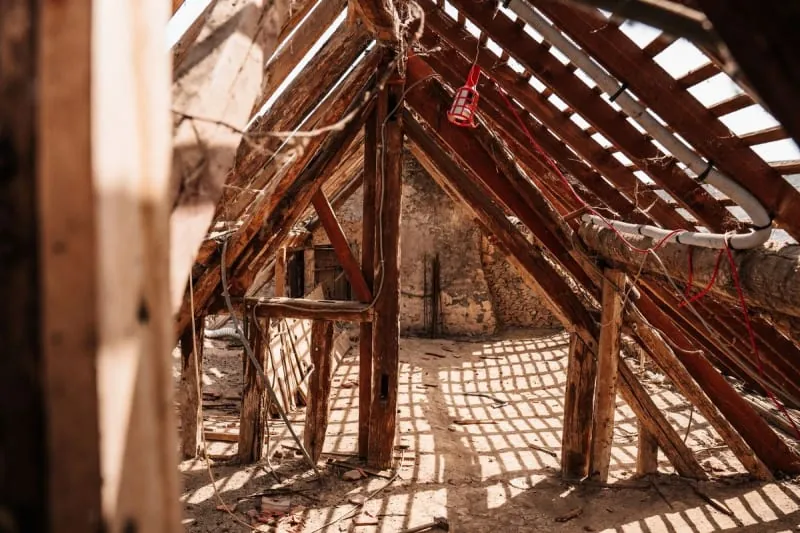
Inspecting roof timbers from inside the loft of a Mansfield house

Your own twice-a-year check, no ladder involved

Rule one: stay off the roof. Everything a homeowner usefully needs to know can be gathered from the ground, an upstairs window and the loft hatch - and the people who ignore that rule keep A&E busier than falling tiles ever have.

  • Across the road, autumn and spring. Sight along the ridge and down the verges. Straight lines should be straight; photograph anything that isn't and compare next time.
  • The loft, bright day, lights off. Pinpricks of daylight are entry points with a postcode. While you're there, sniff - a musty loft is telling you about moisture one way or another.
  • The loft again, during heavy rain. The single best diagnostic hour your house offers. Take a torch and watch where water shows first and which way it travels.
  • Walls and gutters after a downpour. Overflow stripes, drips at joints, water at the base of a downpipe with nowhere to go - all cheap fixes busy becoming dear ones.

"The most profitable sentence in roofing is 'that'll all have to come off'. The most useful one is 'that's a two-hour job' - you'll hear the second from us a lot more often."

Drawn from the surveys Roof Repairs Mansfield carries out

Sorting fact from fear

What's the quickest way to tell a leak from condensation?

Watch the weather, not the water. A leak tracks rainfall - it appears during or just after rain, and it has a defined wet spot. Condensation ignores rain entirely and tracks temperature: it's worst on cold, still mornings, shows up as fine droplets across a wide area of the loft, and brings black mould spotting with it. Damp that worsens during a dry, frosty week has ruled out the leak all by itself.

My roof looks mossy. Is that serious?

By itself, rarely. Moss loves Mansfield's shaded, seldom-rinsed north slopes, but it doesn't cause leaks - its crime is logistical, shedding constantly into gutters and building dams there. Clear the gutters, remove heavy growth if you like, and be sceptical of anyone whose pitch opens with your moss: it's the favourite prop of doorstep roof-cleaning outfits selling treatments nobody needed.

Should I have my roof jet-washed to smarten it up?

We'd advise against it on almost every roof in this town. High-pressure water strips the weathered surface off concrete tiles - ageing them years in an afternoon - drives water under laps, and on old slate can shift fixings that were barely holding on. If appearance matters, gentle hand-removal of moss and a soft-wash treatment achieve it without the collateral damage.

How do I check my own roof without going up there?

Three positions, no ladder. From across the street: sight along the ridge and edges for anything crooked, gapped or missing - binoculars help enormously. From upstairs windows: check gutters for standing water and walls for overflow stripes after rain. From the loft on a bright day, lights off: any daylight through the covering is an address for a repair. Ten minutes, twice a year, catches most problems while they're still cheap.

The house opposite just had their roof done. Should I be worried about mine?

It's genuinely useful information rather than a reason to panic. Streets around here were built in one push, so identical houses carry identical-aged roofs - a neighbour's nail fatigue or perished ridge mortar is a fair preview of what yours is approaching. A free survey converts that hint into facts about your actual roof, which might have years more in it: maintenance history matters as much as birthdate.

Someone knocked saying they'd spotted a problem from the road. Genuine?

Occasionally - but the odds are poor. The knock that follows bad weather, finds urgent problems invisible to you, and wants cash to start immediately is a pattern with a long history in coalfield towns, and it disproportionately targets older residents. Take a name, close the door and get an independent survey; ours are free precisely so nobody has to gamble on a stranger's urgency. A genuine fault will still be a fault next week.

Jump to the fix: Leaks · Chimneys · Gutters · Flat roofs

Word from around the town

What homeowners across the Mansfield patch made of the work, in their own words.

"The back bedroom ceiling had a mark that came and went for two years and I'd stopped even noticing it. When Babet hit it turned into a proper leak overnight. They came out two days later, found a split flashing round the chimney - nowhere near where the stain was - and had it done in a morning. Showed me photos of the fault before and after. The quote and the invoice were the same number, which I'm told is rarer than it should be."
Karen B. - Forest Town
"Ours is one of the old colliery houses and the ridge had been shedding bits of mortar onto the path for months. I expected to be told we needed a new roof - the bloke next door had been quoted for exactly that by someone else. Instead they rebedded the ridge, refixed four tiles and told me the rest of the roof was fine for years yet. Charged a fraction of what I'd braced myself for."
Trevor S. - Warsop
"Water was streaming down the front of the house whenever it rained hard and I assumed the worst about the roof. Turned out the gutter had lost its fall and was tipping everything over the edge in one spot. They reset the brackets, sorted a joint, checked the gully at the bottom and were gone within a couple of hours. Also pointed out a slate that wants watching next year rather than fixing now - appreciated that."
Michelle D. - Ladybrook
"Bought a 1900s terrace near the town centre and the survey flagged the chimney. Two other firms quoted to take it down entirely. These lads went up, told me the stack itself was sound and it just needed repointing with the right mortar, new flaunching and a cap on the dead flue. Three years on the chimney breast is bone dry. Kept the chimney, saved about two grand."
Adam W. - Mansfield Woodhouse
"The extension roof had ponded for years and every couple of winters someone would patch it and it would come back. They were the first to explain the actual problem - no fall on the deck - and quoted to sort that rather than just laying another layer of felt over it. New rubber roof, water actually runs off it now. You get told the truth, which is worth paying for on its own."
Paula H. - Berry Hill

Been a customer?

A short review is the most useful thing you can give a local firm - it tells the next household in Mansfield with a dripping ceiling who they can trust with it.

Matched your symptom? Or didn't?

Either way the next step's the same: a free survey that swaps guesswork for photographs. We'll tell you which of these faults you've got - or that you've got none of them, which happens plenty and costs the same nothing.